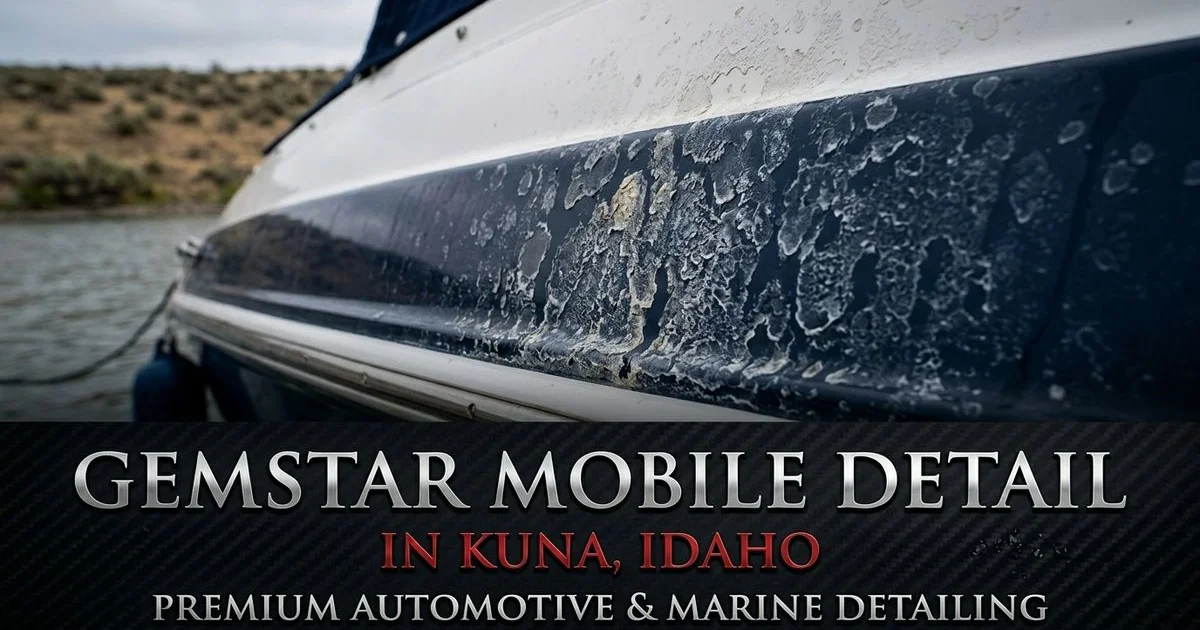
Idaho freshwater is notoriously tough on a boat’s gel coat.
We see the effects of boat hard water spotting from the Snake River and Lake Lowell every single week in the shop.
These specific local waters carry high mineral concentrations that leave bonded deposits behind.
Cumulative damage to your finish is guaranteed if those spots sit too long.
Here is exactly what is happening to your hull and how to stop it.
Mineral content overview
The specific body of water you visit dictates the type of spotting you will face.
We measure significant differences in water hardness across our local lakes and rivers.
Regional groundwater in the Boise area often exceeds 120 parts per million of dissolved calcium carbonate.
All of these environments leave damaging deposits the moment water dries on the gel coat.
| Body of Water | Mineral Profile | Unique Challenges |
|---|---|---|
| Snake River | Moderate to high calcium, magnesium, and silica. | Silica spots are highly resistant to standard cleaners. |
| Lake Lowell | High minerals with summer algae blooms. | Algae and minerals bake into a tough biological crust. |
| Lucky Peak / Cascade | Lower mineral count, cold water. | Condensation pulls atmospheric dust directly onto the hull. |
| Brownlee / Hells Canyon | Extremely high mineral content. | Intense summer heat bakes deposits on almost instantly. |
How damage progresses
Water spotting is a progressive disease for your gel coat.
Our team categorizes this damage into a specific timeline of deterioration.
The process happens faster than most boat owners realize.
Spots can begin etching the finish within 48 hours under the hot Idaho sun.
- Wet boat from regular operation or a quick wash.
- Water dries, leaving behind the concentrated mineral content.
- First-cycle deposit sits on the surface and easily washes off.
- Repeated cycles bond the calcium and silica directly to the gel coat.
- Bonded deposits begin to chemically etch into the gel coat over a period of weeks or months.
- Etching becomes permanent damage that requires physical leveling and correction.
Removal by stage
Choosing the correct removal method depends entirely on how long the spots have been sitting.
We always start with the least aggressive method to protect the thickness of your gel coat.
Using harsh chemicals immediately is a common and expensive mistake.
- Surface deposits: Standard marine wash using the two-bucket method. This physically lifts loose dirt without dragging it across the finish.
- Bonded deposits: Dedicated marine acid cleaners are required here. Products like CarPro Spotless Marine use targeted mild acids to break down calcium. Careful application is mandatory to avoid dulling the finish.
- Etched deposits: Physical Hull restoration with compound work is the only solution. The spots have eaten into the gel coat, so the surrounding surface must be leveled out.
Prevention
Stopping hard water spots before they bond is much cheaper than paying for removal.
Our best advice is to never let untreated water dry naturally on your hull.
A quick wipe-down at the ramp saves hours of compounding later.
- Wash and dry the hull after every single use, ideally within 24 hours.
- Avoid letting raw lake water dry on the gel coat in direct sunlight.
- Apply a dedicated marine wax every 8 to 12 weeks during the season.
- Upgrade to a marine ceramic coating for multi-year UV and mineral protection.
- Keep the boat covered whenever it is stored outside.
Special concern: pontoon and ski boat hulls
Pontoon logs and the sides of heavily loaded ski boats take the brunt of mineral damage. Constant water-line splash creates a concentrated zone of mineral exposure exactly at the waterline stripe.
We pay extra attention to this area during every wash and inspection. This section of the hull always shows the first signs of chalky oxidation and permanent etching.
Frequent wiping of the waterline while the boat is on the water can slow this down significantly.
Marine ceramic on a coated hull
A high-quality ceramic coating creates an extremely slick barrier over the porous gel coat. Mineral deposits release with a simple wash.
No special acid chemicals are needed. We consider this the single biggest reason to coat a frequently used boat.
A coated hull completely changes how you maintain the vessel after a long weekend on the water.