We see boat owners struggle with gelcoat protection every season.
The debate between marine wax vs marine ceramic coatings comes up in almost every consultation.
Our team finds that the right choice strictly depends on how you use and store your vessel.
Let’s look at the data and explore practical ways to protect your investment.
Marine Wax
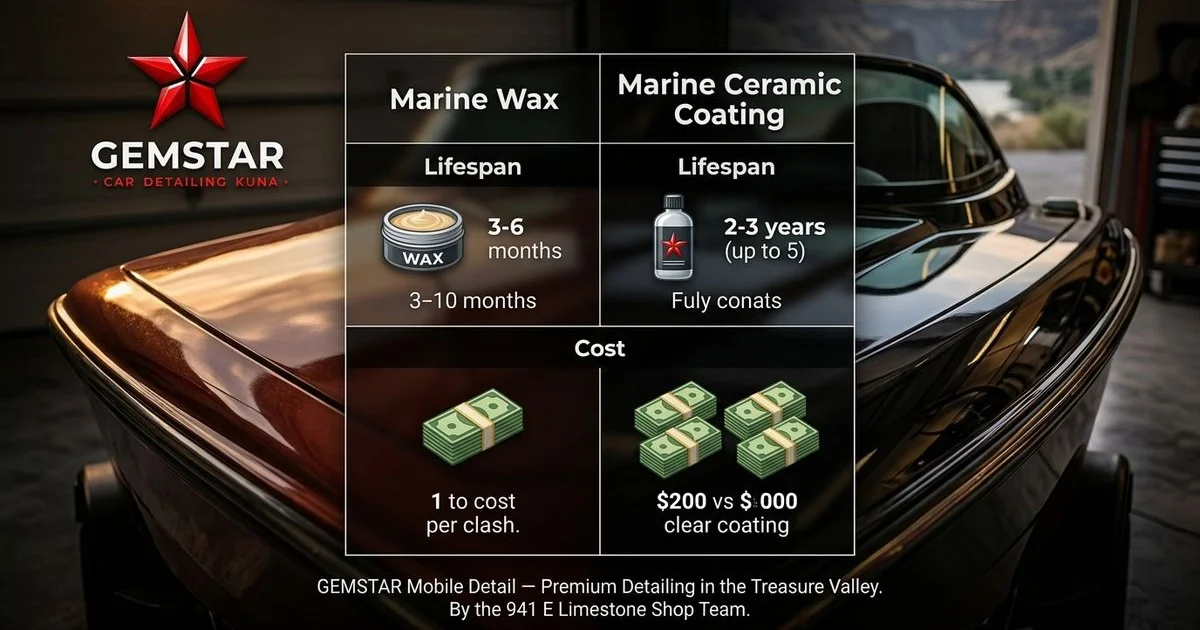
Marine wax provides a classic, deep gloss that protects your gelcoat for two to six months. You can expect to pay $150 to $400 for a professional application. We appreciate the simplicity of a good carnauba or polymer blend.
Detailing experts and our own technicians frequently use proven standards like Collinite 885 Fleetwax or Meguiar’s Flagship Premium Marine Wax. These products handle light oxidation beautifully and provide strong UV defense.
- Lifespan: 2 to 3 months for heavy use, 4 to 6 months for light use.
- Cost: $150 to $400 per professional application.
- Pros: Lower upfront expense, easier touch-ups, and a classic deep gloss.
- Cons: Requires frequent reapplication, offers zero impact resistance, and breaks down quickly under the harsh US sun.
A major drawback is the constant need for reapplication. You will spend more time maintaining the finish instead of enjoying the water.
Marine Ceramic
Marine ceramic coating delivers a multi-year, hydrophobic barrier that lasts two to five years. Professional installation typically costs between $1,499 and $3,000 depending on vessel size. We consider this the superior defense against salt, UV rays, and grime.
The technology actually bonds with the porous gelcoat to create a hardened shell. Our recent projects often utilize advanced 2026 formulations like System X Max G+ or Gtechniq Marine Ceramic Top. These modern options push standard pricing to around $100 to $125 per linear foot, but the long-term protection is undeniable.
- Lifespan: 2 to 5 years depending on the tier and maintenance.
- Cost: $1,499 to $3,000 or more for professional prep and application.
- Pros: Multi-year durability, extreme hydrophobicity, easier washing, superior UV resistance, and measurable surface hardness.
- Cons: Higher upfront cost, requires intense professional preparation, and mistakes during application are difficult to fix.
Prep work accounts for 80 percent of the labor. Skipping the heavy-cut compounding phase will trap oxidation right under the clear layer.
Use-case decision matrix
Comparing marine wax vs marine ceramic requires looking at your specific boating habits. Marine wax suits lightly used, covered boats, while ceramic is best for heavy outdoor use. We evaluate the storage method, frequency of use, and ownership timeline to make a clear recommendation.
| Boating Scenario | Recommended Protection | The “Why” Behind the Choice |
|---|---|---|
| Light seasonal use, stored covered indoors | Marine wax | Sufficient protection for minimal UV exposure. |
| Heavy seasonal use, outdoor stored | Marine ceramic | Better long-term defense against constant sun and salt. |
| Lake season + winter storage | Either | Both work, but ceramic preserves the finish better over winter. |
| Show or premium boat | Marine ceramic | Mandatory for a flawless, mirror-like show finish. |
| Selling within 2 years | Marine wax | Do not pay for a 5-year ceramic if you will not keep the boat. |
This framework simplifies the entire process. We always advise clients to match the product to their realistic schedule. Overpaying for performance you never use makes little financial sense.
Cost-per-year math (5-year horizon, heavy use)
Ceramic wins the long-term financial battle for heavy users. Over a five-year period, marine wax costs double the amount of a single ceramic application.
Our accountants like to break down the numbers to show the true cost of ownership. Frequent wax applications quickly drain your maintenance budget.
- Marine wax: $300 average per application x 4 applications per year x 5 years = $6,000.
- Marine ceramic: $2,000 initial application + $200 per year for basic maintenance = $3,000.
The numbers clearly show that ceramic wins per year for heavy use. Wax only wins the financial calculation for light, occasional use where one annual application is enough.
Hybrid approach
Many boat owners choose a hybrid method by applying ceramic on the hull and wax on the deck. This is a highly reasonable middle path that balances budget and durability.
We recommend this strategy for clients wanting maximum value. The hull represents a high-value surface that requires multi-year protection against water spots and scum lines. Decks experience heavy foot traffic and require more frequent refreshing.
Applying a slick ceramic coating to a textured deck can create a dangerous slipping hazard. A specialized marine wax or polymer deck sealant provides protection while maintaining the necessary non-skid friction.
Our crews find that maintaining a waxed deck takes very little time. You get the high-tech defense where it matters most and manageable upkeep where wear is highest.
Honest take
When settling the marine wax vs marine ceramic debate for a boat you will own for five or more years, ceramic is the clear winner. For everything else, traditional marine wax is perfectly fine.
We stand by this simple rule for every assessment. Your time on the water is valuable. Protecting your vessel should never become a stressful chore.
Review your options and set up a proper maintenance schedule.