We see the debate over a mobile ceramic coating vs shop application happen every single week.
As a professional detailing team, that conversation usually starts when someone asks why a five-year coating cannot happen in their driveway. The short answer is that high-end chemical bonds demand a flawless environment.
We operate as a hybrid mobile detailer for nearly all standard jobs. Multi-year ceramic coatings require intense precision.
We simply do not perform multi-year ceramic coatings on a mobile basis. Here is the science behind our strict rule.
What ceramic coating cure needs
A proper ceramic coating cure requires strict temperature control, low humidity, and zero dust to allow the liquid polymers to harden. High-end products like CarPro CQUARTZ or Gtechniq Crystal Serum Light rely on a chemical process called cross-linking to bond with your clear coat.
We carefully monitor these atmospheric conditions in our shop. The ideal temperature sweet spot in the US is strictly between 60 and 80 degrees Fahrenheit. Humidity plays an equally critical role during this sensitive phase.
Our technicians need humidity levels between 40 and 60 percent for the solvent to evaporate correctly. High humidity traps moisture and creates a cloudy finish. Low humidity speeds up the flash time too quickly and creates dark, oily patches known as high spots.
- Stable temperature: 60-80°F is required for predictable cross-linking.
- Specific humidity control: 40% to 60% relative humidity is the safe zone.
- Dust-free environment: Zero airborne contaminants for the initial flash period.
- Undisturbed time: 12 to 24 hours of zero water or wind exposure.
What a residential driveway provides
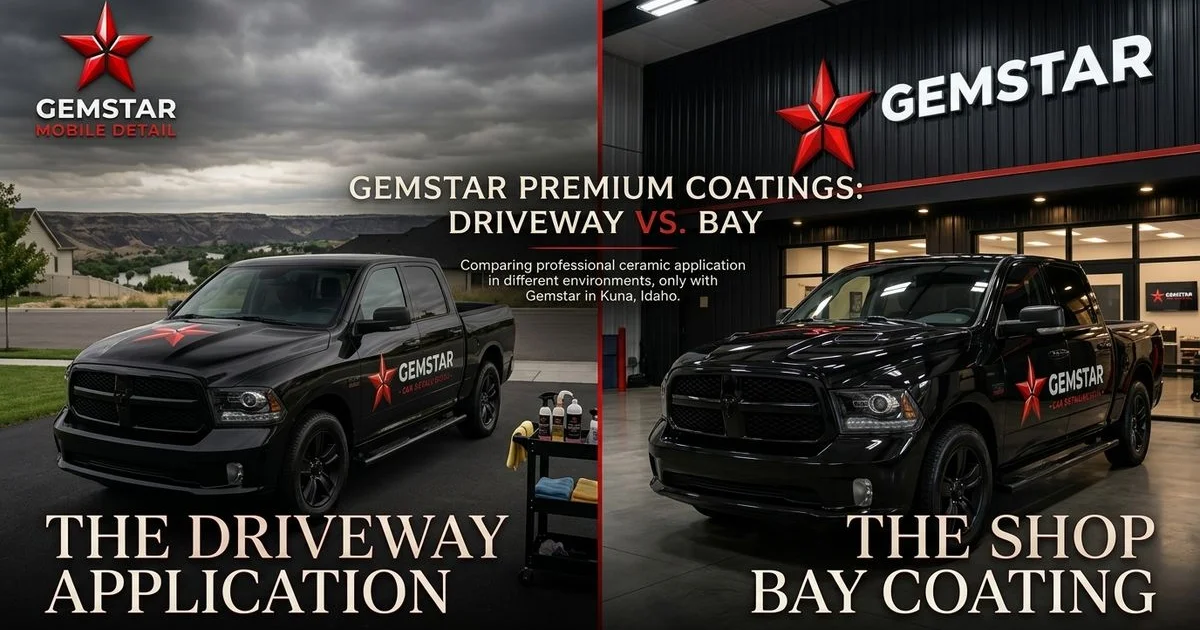
We see residential driveways provide a chaotic, uncontrolled environment filled with wild temperature swings and airborne debris. This makes the delicate 24-hour initial curing phase nearly impossible to manage correctly.
Spring and summer days easily feature temperature swings of 10 to 30 degrees between morning and night. We know this volatility stops the cross-linking process right in its tracks. Wind is another major enemy during an outdoor application.
A slight breeze introduces pollen, tree sap, and passing canyon dust directly onto the tacky, wet clear coat. Our detailers watch these contaminants embed into the finish before it ever has a chance to harden.
- Variable temperature: 10-30°F daily swings completely disrupt the chemical bonding.
- Variable humidity: Unexpected rain, morning dew, or ambient changes introduce moisture too early.
- Dust contamination: Passing cars and wind embed microscopic dirt into the soft finish.
- Risk of disturbance: Kids, pets, and falling leaves can ruin the surface before it hardens.
Real-world consequence
We find that mobile ceramic on a driveway typically shows visible swirl haze and premature failure within 12 to 18 months. The uncontrolled environment forces an inconsistent cure, preventing the coating from achieving its true 9H hardness rating.
The bonding to the clear coat is incomplete when temperatures fluctuate wildly. We regularly fix the fallout from these failed outdoor applications. The famous hydrophobic water-beading effect simply does not develop fully.
Customers pay premium prices for three or five-year coatings from mobile-only operators, only to experience severe water spotting shortly after. Our shop handles dozens of these specific redo jobs every year. Fixing this requires an expensive, full paint correction to strip the bad coating.
| Coating Characteristic | Controlled Shop Result | Driveway Application Result |
|---|---|---|
| Chemical Bond | Complete molecular cross-linking. | Incomplete bond with clear coat. |
| Finish Clarity | Deep gloss and clear reflection. | Cloudy haze and high spots. |
| Longevity | True 3 to 5 years of protection. | Fails within 12 to 18 months. |
When mobile ceramic might be OK
We find that mobile ceramic might be acceptable if you use short-term spray sealants or have a heavily controlled, enclosed home garage. True, multi-year coatings are never a safe bet in the open air.
Flexible SiO2 spray sealants are fantastic for driveway detailing. Our team highly recommends products like Meguiar’s Hybrid Ceramic Wax or Turtle Wax ICE Seal N Shine for great hydrophobic protection without the strict temperature demands. These formulas provide an impressive two to six months of durability.
The chemistry behind these sprays is far less critical. We love applying these alternatives because they do not require a 24-hour undisturbed cure time to perform well.
- 1-year ceramic in controlled garage: Requires strict dust mitigation and is still risky.
- Ceramic spray sealants: Different chemistry makes the cure time highly forgiving.
- Ceramic-infused waxes: Great for months of protection, rather than years.
For a guaranteed, multi-year finish, an indoor application is the only right answer.
We offer free pickup and delivery within a 5-mile radius to make this process completely painless for our clients.
Protect your investment the right way and schedule a Drop-off ceramic coating.