We regularly see the frustration on a customer’s face when their car loses its shine, assuming a quick wash will fix canyon dust paint damage. This fine alkaline powder from the high desert plateau acts like a slow-moving chemical peel on your car’s finish.
The local agricultural soils and desert loess blow directly across Kuna, creating conditions that permanently etch microscopic craters into your clear coat.
We will explain exactly what this damage looks like, the science behind it, and the precise steps required to restore your vehicle’s gloss. Identifying the problem early is the best way to save your factory paint.
How canyon dust paint damage looks
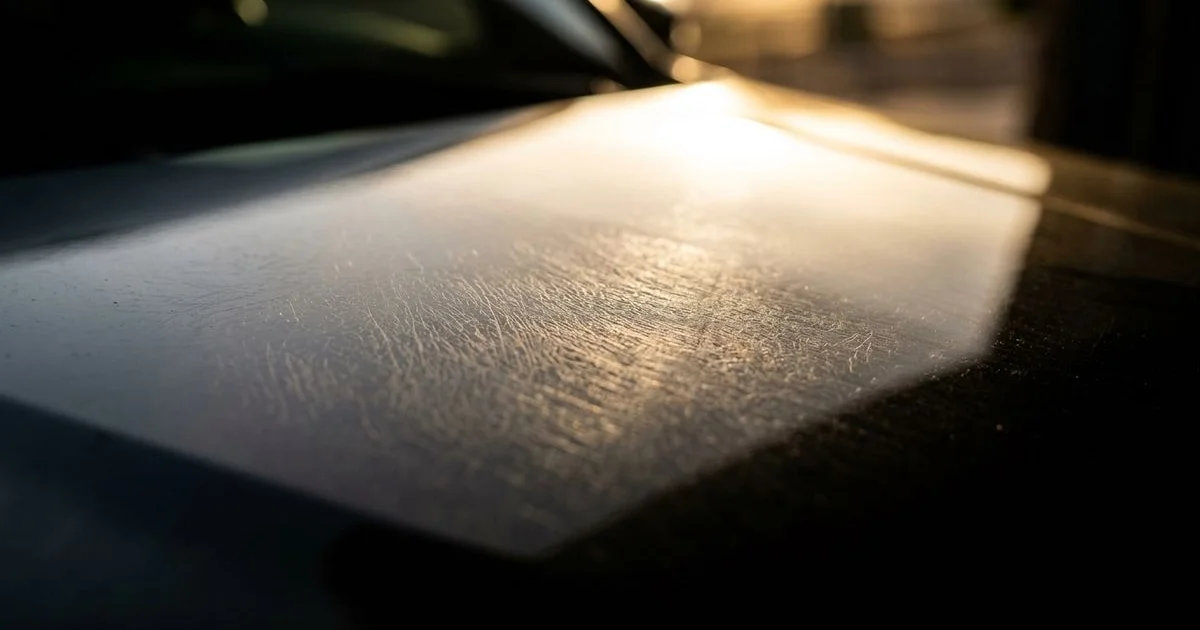
Damage from canyon dust appears as a permanent, cloudy haze and distinct water spots that simply will not wash off. Microscopic craters form on the horizontal panels that catch the most sun.
We measure modern factory clear coats at just 1.5 to 2 mils thick, which is roughly the thickness of a standard Post-it note. Because this protective layer is so thin, the high-pH dust etches away the glossy surface fast.
- Hazy clear coat that refuses to shine after a standard wash.
- Faded “ghosting” rings that appear faintly after the hood dries.
- Stubborn water spots caused by minerals calcifying into the paint layer.
- Premature dulling focused heavily on the hood, roof, and trunk.
- Severe loss of color depth due to micro-scratches scattering the light.
How damage progresses
The breakdown happens when dry dust gets wet and turns into a caustic, high-pH solution. Water from morning dew or a stray sprinkler activates this alkaline dirt.
Our detailing specialists test the local Snake River Plain soils at a highly reactive pH level of 8.0 to 8.5. The resulting chemical paste eats directly into the finish over time.
- Dust settles on dry paint (harmless in a completely dry state).
- Moisture hits the dust (morning dew or light rain) and creates an alkaline paste.
- High-pH minerals chemically burn into the 50-micron clear coat layer.
- Washing removes the visible dirt but leaves the microscopic craters behind.
- Repeated cycles over several months create a thick, visible haze.
What removes it
Professional machine polishing is the only way to physically level out the etched clear coat. Auto manufacturers specify that a maximum of 8 microns of clear coat should be removed over a vehicle’s entire lifespan.
We use specialized abrasive compounds to safely remove a microscopic fraction of the damaged paint without violating that limit. A heavy hand can easily burn through this vital UV protection layer.
This careful approach requires specific stages of correction based on the severity of the alkaline burns. Our technicians rely on digital paint thickness gauges before starting any heavy cutting to verify the remaining clear coat depth.
| Damage Level | Correction Method | Starting Cost | What It Achieves |
|---|---|---|---|
| Light Etching | Single-stage paint enhancement | $349 | Clears up to 65% of minor haze and restores base gloss. |
| Moderate Etching | Two-stage correction | $649 | Removes deeper mineral spotting and heavy swirl marks. |
| Severe Etching | Three-stage correction | $1,099 | Safely levels deep craters and restores severely oxidized paint. |
What prevents it
Creating a physical barrier between the paint and the alkaline dirt is the best defense. Standard carnauba waxes melt quickly in the intense Idaho summer sun.
Our preventative strategy focuses on keeping the surface extremely slick so caustic minerals cannot bond. Local weather conditions require a much stronger chemical barrier to stop oxidation.
A true 9H ceramic treatment cures into a hard shell that stops Kuna’s high-pH dust from reaching the factory paint. We highly recommend applying an SiO2 based ceramic coating for long-term survival.
- Frequent hand washing every 7 to 10 days during the hot summer months.
- Applying wax, a synthetic sealant, or a ceramic coating protective layer.
- Storing the vehicle in a garage to avoid morning dew cycles.
- Removing visible dust quickly before the next rain shower hits.
Pro Tip: Never wipe dry canyon dust off your car with a dry towel. This acts like sandpaper and instantly creates deep micro-scratches across the finish.
Why correction-then-protection makes sense
Applying a high-end coating over etched paint is a costly mistake. Doing one step without the other leaves the job completely unfinished.
Our team refuses to install a long-term coating without properly leveling the clear coat first. Correction removes the existing chemical burns, while the ceramic layer provides the new defense.
- Correction alone: The porous, freshly polished paint has no defense, and alkaline damage returns within months.
- Protection over damaged paint: The SiO2 polymers bond directly to the dirt, locking in the cloudy haze permanently.
This exact chemical reality is why preventing canyon dust paint damage requires a combination of correction and ceramic coating for keeper vehicles. We see too many vehicles permanently ruined by shops that skip the vital polishing phase.
See paint correction and ceramic coating to learn how these processes protect your investment.