You know how some freshly detailed cars look incredible for a month, only to start fading rapidly? The secret difference usually comes down to what happens before the polishing even begins.
Paint depth measurement is what separates real paint correction from a risky buffer-and-pray approach.
We are going to break down the exact tools required for this process and explain what the numbers mean. Then, you will see exactly how this data protects your vehicle from permanent damage.
The paint depth measurement tool
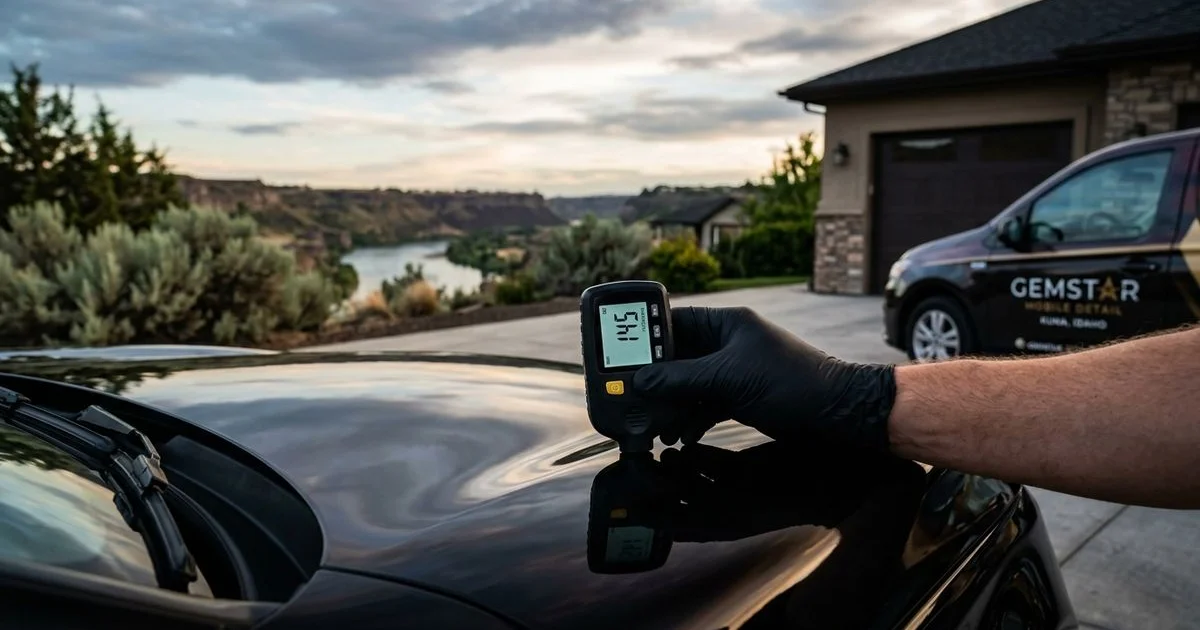
Our technicians rely on specialized paint depth gauges to assess your vehicle. These hand-held digital tools use magnetic or eddy-current technology to read thickness in either microns or mils.
A mil equals one-thousandth of an inch, which is the standard measurement for automotive finishes in the US. Professional equipment requires a serious investment.
A standard metal-reading unit like the DeFelsko PosiTest DFT costs between $400 and $1,500.
| Gauge Technology | Target Material | Average Cost |
|---|---|---|
| Magnetic | Steel panels | $300 - $1,000 |
| Eddy-Current | Aluminum panels | $400 - $1,500 |
| Ultrasonic | Plastic, Carbon Fiber | $1,800 - $4,000 |
We must use advanced ultrasonic meters if your car features carbon fiber or plastic panels. These specialized tools often exceed $1,800.
What it measures
These devices measure the total paint thickness sitting above the raw steel, aluminum, or plastic substrate. Modern factory paint is incredibly thin.
We typically see global factory averages between 110 and 125 microns, which equals about 4.3 to 4.9 mils.
Here is a breakdown of a standard OEM finish today:
- Primer: 8-38 microns
- Color coat: 13-38 microns
- Clear coat: 38-50 microns
- Total Average: 95-125 microns
American manufacturers like Ford and GM consistently produce vehicles with thinner paint systems. These cars often measure right around 95 to 105 microns straight from the factory.
Tesla vehicles present another unique challenge. Their factory paint is often soft and can show inconsistent thickness levels.
We consider measurement absolutely critical on these models before any polishing begins.
What we record
Our standard procedure involves taking detailed measurements across the entire vehicle to map its true condition. This protects you by revealing exactly what is happening beneath the surface.
We document the following data points during an inspection:
- Multiple readings per panel (hood, doors, fenders, roof)
- Specific locations (corners, center, and one inch from edges)
- Panel averages alongside the minimum and maximum range
- Standard deviation spikes that indicate past repairs
Taking just one reading per panel is a common mistake. Edges routinely measure up to 25% thinner than flat centers.
We use these comprehensive logs to spot hidden body filler or undisclosed collision repairs. Spotting these issues early prevents anyone from burning through the paint with a polishing pad.
Reading a measurement
Interpreting the gauge output tells us the exact history of your car. Modern factory paint usually falls into a very specific range.
We look for readings between 95 and 125 microns to confirm a factory original finish. Anything significantly outside this window changes our approach.
Here is how the numbers on our digital displays break down:
- 95-125 microns: Healthy factory paint with adequate clear coat.
- 75 microns or lower: A major red flag indicating prior heavy correction or paint failure.
- 180-300 microns: Evidence of a minor respray or panel blending.
- 600+ microns: Serious collision repair masking thick body filler.
Finding a reading of 75 microns means the clear coat is dangerously thin.
We will advise against aggressive polishing in these spots to prevent permanent damage. That conservative choice keeps your vehicle looking great for years.
During correction
After completing a test panel, we measure the surface again to calculate exactly how much material was removed. This step guarantees your finish remains safe.
The clear coat layer contains vital UV inhibitors that prevent the underlying color from fading in the harsh US sun. Manufacturers generally recommend removing no more than 8 microns during a heavy polishing session.
“Removing more than 8 microns of clear coat destroys the paint’s natural UV defense and accelerates early fading.”
We typically aim to remove just 1 to 3 microns during a standard correction. This small amount leaves plenty of protection behind.
Your vehicle deserves a conservative approach that ensures the result matches our expected safety range. We verify these test numbers before proceeding to polish the rest of your panels.
After correction
Our final sweep of the vehicle involves one last round of thickness measurements. This confirms the total removal stayed well within the safe factory limits.
We compile this final data and share the exact numbers directly with you. This transparency provides several practical benefits:
- Confirms the clear coat retains its UV protection
- Acts as a baseline condition report for your records
- Protects the value of your asset for future resale
You gain complete peace of mind knowing your vehicle was improved rather than compromised. It proves the job was done safely.
Why most shops skip paint depth measurement
Proper measurement requires a significant investment of both time and tooling capital. A quality gauge takes time to calibrate and read, adding roughly 15 to 30 minutes to a standard job.
We invest in these tools because guessing is simply too risky on modern factory paints. Many high-end ultrasonic gauges cost upwards of $4,000, which causes budget shops to skip this vital step entirely.
Skipping the gauge might save a shop time, but it transfers all the risk directly to your vehicle’s clear coat. If you want a service that prioritizes the long-term health of your vehicle through proper paint depth measurement, See paint correction tiers.