From what we’ve seen in the auto detailing industry, achieving that liquid, glass-like finish is a science, not a mystery. Most cars lose their factory clarity much faster than owners realize due to automated washes and harsh UV exposure.
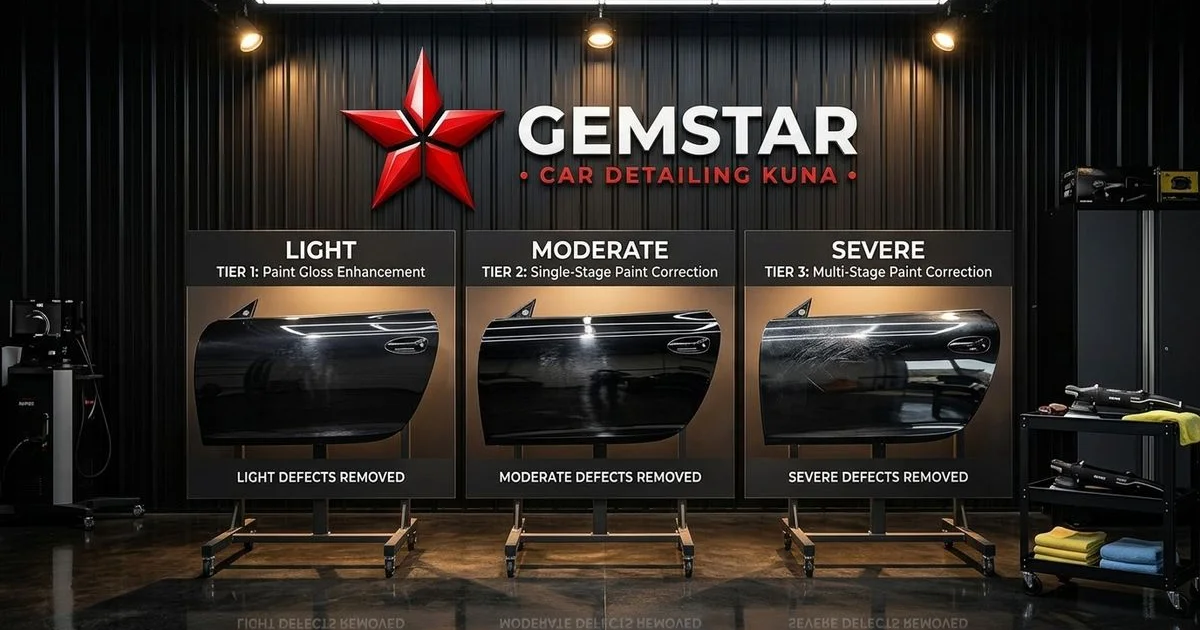
Our technicians find that single vs two vs three stage paint correction comes down to matching the abrasive method to the exact depth of your vehicle’s defects.
The factory clear coat on a modern US vehicle is incredibly thin, often measuring just 40 to 60 microns. We must be surgical with our polishing approach to avoid causing permanent damage. Let’s examine the three main correction levels, what they actually remove, and the precise inspection process used to protect your investment.
Single-Stage Enhancement ($349)
Single-stage paint enhancement provides a massive boost in gloss while preserving the maximum amount of factory clear coat. Our standard process involves a medium foam pad paired with a diminishing abrasive compound on a dual-action polisher. The goal is to smooth out the surface without cutting too deeply into the fragile clear coat structure. We recommend this service for relatively new or highly maintained cars.
This entry-level correction removes only 1 to 3 microns of clear coat, making it a very safe maintenance procedure. Our detailers typically complete this service in a swift 2 to 3 hours. You can expect to erase surface-level issues like minor water spots, light oxidation, and the micro-marring caused by friction from dirty wash mitts.
- Methodology: One pad and a versatile polishing compound.
- Defect Target: Removes light swirl marks, shallow water spots, and light oxidation.
- Material Removed: 1 to 3 microns of clear coat.
- Time Commitment: 2 to 3 hours of dedicated work.
- Ideal Candidate: 0 to 3 year old vehicles, regular maintenance-grade correction, or basic prep before applying a sealant.
Two-Stage Correction ($649)
Two-stage correction steps up the aggression by separating the heavy cutting phase from the final polishing phase. We use a stiff cutting pad with a heavy compound first to level out deeper damage, followed by a soft pad and finishing polish to restore optical clarity. This is widely considered the industry sweet spot for daily driven vehicles in the US. Our technicians find this method eliminates about 80 to 90 percent of visible surface defects.
A two-stage approach safely shaves off 3 to 6 microns of clear coat to reveal fresh, undamaged paint underneath. This depth is necessary to tackle stubborn problems like random isolated deep scratches (RIDS), severe hard water etching, and moderate oxidation. We advise booking a two-stage correction if you are planning to invest in long-term surface protection. The resulting pristine surface ensures maximum bonding for advanced chemical coatings.
- Methodology: Heavy cutting compound followed by a dedicated finishing polish.
- Defect Target: Removes moderate swirl marks, RIDS, moderate oxidation, and deeper water etching.
- Material Removed: 3 to 6 microns of clear coat safely leveled.
- Time Commitment: 4 to 6 hours of continuous machine work.
- Ideal Candidate: 3 to 7 year old vehicles, daily drivers, and mandatory prep before ceramic coating.
Three-Stage Show Correction ($1,099)
Three-stage show correction is an intensive, multi-step restoration reserved for severely neglected paint or high-end show cars. We initiate this service with a highly abrasive compound on a rotary polisher to cut through deep damage, followed by a medium polish, and finally a specialized jewelry polish. A process this aggressive removes 5 to 10 or more microns of clear coat. Our team strictly reserves this package for vehicles with sufficient measured paint depth.
This heavy-duty leveling is the only way to fix prior bad corrections, like holograms left by inexperienced detailers, along with severe oxidation and deep water etching. We require a vehicle drop-off for this service because the precision compounding and polishing takes a full 6 to 10 hours. Attempting to rush a three-stage correction can easily overheat the panel or burn completely through the clear coat layer.
- Methodology: Heavy cutting compound, medium refining polish, and ultra-fine finishing polish.
- Defect Target: Removes severe defects, deep oxidation, heavy water etching, and prior bad correction marks.
- Material Removed: 5 to 10+ microns removed, permitted only if paint depth allows.
- Time Commitment: 6 to 10 hours of precision work, requiring a shop drop-off.
- Ideal Candidate: Show vehicles, severe neglect restoration cases, and premium custom builds.
How we pick
A professional vehicle inspection dictates the exact correction package we recommend for your specific car. Our assessment always begins in a controlled environment using high-powered Scangrip LED swirl finder lights. These specialized detailing lights replicate harsh sunlight to expose hidden holograms and micro-scratches that standard garage lighting hides. We refuse to guess about the structural integrity of your vehicle’s finish.
Following the visual inspection, the technician uses an ultrasonic tool like the DeFelsko PosiTector 200. This advanced gauge reads the exact thickness of your clear coat in microns. Our policy is to test the least aggressive pad and compound combination on a small section first. The technician will only step up to a heavier cut if the initial test fails to yield the required clarity.
- Visual Audit: Illuminating the paint with Scangrip LED lights to reveal hidden defects.
- Depth Measurement: Using DeFelsko ultrasonic gauges to verify the total clear coat thickness.
- Test Spot: Performing a minimal-abrasion test to evaluate the paint’s hardness and correction response.
When more stages aren’t safe
Sometimes the remaining clear coat is simply too thin to withstand aggressive machine compounding. Our ultrasonic gauge might reveal a total paint depth below the safe 60-micron threshold, or an estimated clear coat thickness under 25 microns. A heavy three-stage correction is no longer a viable option under these risky conditions. We prioritize the long-term health of your paint over a temporary, flawless shine.
Attempting a heavy cut on compromised paint will inevitably cause a catastrophic clear coat failure. Our local auto body shop partners report that repainting a single damaged panel often starts around $500. A single or two-stage enhancement may still be possible to improve gloss without risking permanent damage. We will always discuss these physical limitations with you transparently before touching a buffer to the car.
Expert Warning: Burning through a thin clear coat cannot be polished out. The only fix for a compromised clear coat is a costly trip to a professional auto body shop for a full panel respray.
Pair with protection
Removing scratches leaves your raw clear coat completely unprotected from future environmental damage. We strongly insist that all correction tiers be paired with a high-quality synthetic sealant at a bare minimum. A 2026 detailing market report shows that the vast majority of vehicle owners now opt for a durable nano-ceramic layer instead of traditional wax. Our application process seals the freshly leveled paint to lock in that pristine shine.
A multi-year ceramic coating provides a hardened, hydrophobic barrier that actively resists new wash-induced micro-scratches. We consistently see these advanced coatings extend the life of a paint correction by years compared to unprotected vehicles.
Ready to restore your vehicle’s factory shine? Book paint correction.