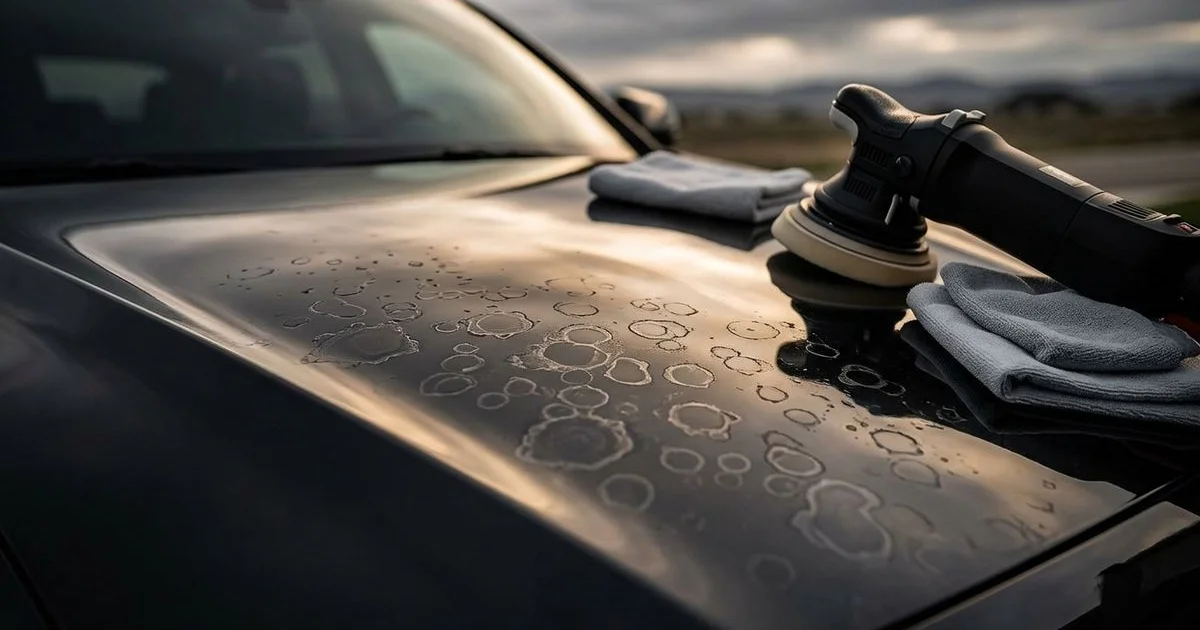
Dealing with chalky white rings on a dark hood makes hard water spot removal a frustrating reality for anyone parking outside in our area. Our crews see this daily across local neighborhoods and commercial lots. Those stubborn marks are actually heavy mineral deposits left behind when local water evaporates on hot paint.
The official city water hardness clocks in at 137.73 mg/L, which firmly places it in the “hard water” category. We understand how ordinary washing completely fails to remove these baked-on calcium crusts.
This guide breaks down the science behind the spotting and outlines the exact correction methods that safely restore a flawless finish.
What hard water spots are
Hard water spots are physical accumulations of calcium carbonate, magnesium, and silica deposits. They form rapidly when mineral-laden water dries directly on your paint.
We frequently notice that these alkaline minerals create a strong chemical bond with the clear coat over time. Normal car wash soaps are pH-neutral and simply cannot dissolve these highly alkaline crusts.
The damage progresses from a simple surface deposit that washes right off into a severe etching problem. Our technicians see severe clear coat damage when these spots bake in the hot summer sun.
Once the minerals etch into the surface, an acidic chemical reaction occurs that physically pits the paint.
Here is how the chemistry impacts your vehicle:
- Calcium and magnesium dry into a chalky white residue.
- Silica deposits form a glass-like shell that resists normal scrubbing.
- The alkaline nature of the minerals requires an acidic cleaner for safe breakdown.
Three stages of hard water spot removal
The severity of mineral damage falls into three distinct stages based on how long the deposits sit on the vehicle. Recognizing these timeframes is critical for choosing the correct approach.
We categorize these spots to prevent unnecessary and aggressive scrubbing on a delicate clear coat. A simple visual inspection usually reveals whether you are dealing with a fresh mark or a deep etch.
| Stage | Timeframe | Characteristics | Required Action |
|---|---|---|---|
| Stage 1: Surface deposit | Under 1 week | Chalky rings resting gently on the top layer. | Washes off with regular soap and water. |
| Stage 2: Bonded deposit | 1 to 4 weeks | Minerals have hardened and stuck to the paint. | Requires an acidic cleaner or dedicated mineral dissolver. |
| Stage 3: Etched into clear coat | 4+ weeks | Minerals have eaten past the surface, creating craters. | Requires paint correction to remove. |
What removes each stage
Removing mineral deposits requires matching your chemical or mechanical approach to the specific stage of the spot. Using aggressive abrasives on a fresh surface mark wastes time and damages your paint.
Our standard protocol always starts with the least aggressive method possible. A standard two-bucket hand wash easily handles Stage 1 surface deposits.
For Stage 2 and Stage 3 problems, specific tools are required:
- Chemical Dissolvers: We recommend using a dedicated water-spot remover like CarPro Spotless 2.0, Iron-X, or Bilt-Hamber spot remover for Stage 2 spots.
- Targeted Acids: Products like CarPro Spotless 2.0 utilize a specific pH 4 acid formula to safely dissolve the alkaline crust.
- Vertical Cling Gels: Heavy duty gel removers also work exceptionally well because they cling to door panels without running off immediately.
- Mechanical Polishing: Our team uses single-stage to two-stage paint correction to level the clear coat for stubborn Stage 3 spots depending on depth.
The depth of the etching dictates exactly how much compounding the surface needs. This physical leveling is the only way to fix craters permanently.
What prevents
Preventing hard water spots requires keeping mineral-heavy water from drying on your vehicle’s surface. Rapid drying and protective barriers are your best defenses against permanent etching.
We strongly advise clients to avoid sprinkler overspray whenever possible. When municipal or well water dries directly on paint, a thick mineral deposit is left behind instantly.
Here are the most effective strategies to block mineral damage:
- Immediate Drying: Wash and dry the vehicle quickly after any rain or morning dew using a clean microfiber towel.
- Hydrophobic Protection: Our preferred prevention method is applying a durable Ceramic coating to the exterior, which makes mineral deposits release with a simple wash.
- Physical Barriers: Use a cover or garage during high-mineral water exposure to protect the paint.
- Shade Washing: Always wash your car in the shade to prevent the sun from flash-drying tap water droplets.
We see the highest risk in areas with lake-side parking and heavy sprinkler zones. Staying proactive in these environments saves hours of painful polishing later.
Special case: Lake Lowell
Treat Lake Lowell exposure as a continuous, high-risk mineral event for your vehicle. The boat staging areas and lakeside parking expose vehicles to a constant aerosol mist generated by waves and wind.
Our technicians consistently pull heavy, baked-on silica crusts off trucks parked near this specific reservoir.
“This airborne moisture acts like a slow-motion sprinkler system that covers your clear coat in hard water before you even leave the ramp.”
A multi-year ceramic coating is absolutely the best long-term answer for this environment.
We highly suggest keeping a quick detailer spray in your trunk for immediate wipe-downs after leaving the launch ramp. A fast spray and wipe neutralizes those fresh lake water droplets before they harden in the afternoon sun.
Special case: well water
Using unfiltered well water to wash your car is counterproductive because it actively adds new mineral deposits to the paint. Many local Kuna properties sit on private wells with high mineral content far exceeding the city’s 137 mg/L average.
We constantly warn property owners that relying on untreated rural aquifers creates a continuous cycle of spotting and scrubbing. You must never use this raw water for exterior detailing.
If you are on a private well, you have two safe options for washing:
- Switch Sources: Use municipal water for your wash buckets and final rinse.
- Filter the Flow: Install a dedicated deionizing filter system, like the CR Spotless DI-120, for your outdoor hose spigot.
Our crews recommend the deionizing setup because it pulls the calcium and magnesium out of the flow. This drops the total dissolved solids down to zero parts per million for a spot-free rinse.
See exterior detailing to learn more about setting up a flawless wash routine.
Proper hard water spot removal preserves the value and beauty of your investment. We encourage you to evaluate your current washing setup today and reach out if your clear coat needs professional leveling.