We hear the same standard advice online all the time about washing vehicles every two weeks.
If you are searching for “how often wash car Kuna”, that generic rule completely ignores the realities of our local climate. Local conditions require a completely different approach to maintenance.
Our team sees exactly what alkaline dirt and winter road treatments do to paint in the Treasure Valley. Preventing permanent damage takes precise timing.
Consistent care protects your clear coat. We will lay out the exact timelines for this specific weather below.
Kuna-appropriate wash schedule
The ideal frequency is every 7 to 10 days during the summer and every 10 to 14 days during the winter. Precise timing stops the chemical reactions from starting.
Our standard schedule adapts to the specific seasons in Ada County.
- Summer (May-September): Wash every 7 to 10 days to combat the average July high of 93°F.
- Winter (November-March): Wash every 10 to 14 days to clear away liquid magnesium chloride.
- Spring/Fall: Wash every 7 to 14 days depending on rainfall and farm equipment activity.
- After visible dust event: Rinse and wash within 48 hours.
- After mag chloride exposure: Wash within 48 hours to halt active corrosion.
Why more frequent
We wash frequently because local contaminants actively destroy clear coats if left unattended. Snake River canyon dust contains high levels of alkaline minerals. Frequent cleaning breaks this chemical cycle before the damage compounds.
Our experience shows that when this dust mixes with morning dew, it aggressively etches paint. Winter road treatments like Mag chloride present another severe chemical threat during the colder months. These salts are hygroscopic, meaning they constantly pull moisture from the Idaho air.
We see the aftermath of this gooey substance sticking to undercarriages all season. A 2025 AAA study noted that de-icing methods cause nearly $3 billion in vehicle rust damage annually across the country. The corrosion remains active until you completely wash it away.
Hand wash only
Our technicians insist on hand washing because automated options cause progressive damage over time. Automated brush washes slap dirty bristles against your paint. Those stiff brushes add swirl marks faster than farm dust adds etching.
We test local city water and find it averages 137 parts per million of hardness. Touchless washes compensate for this hard water by using highly alkaline detergents. These harsh chemicals strip away your expensive wax or sealant prematurely.
Our team relies entirely on the traditional hand wash to consistently clean a car without compromising the finish.
Two-bucket method
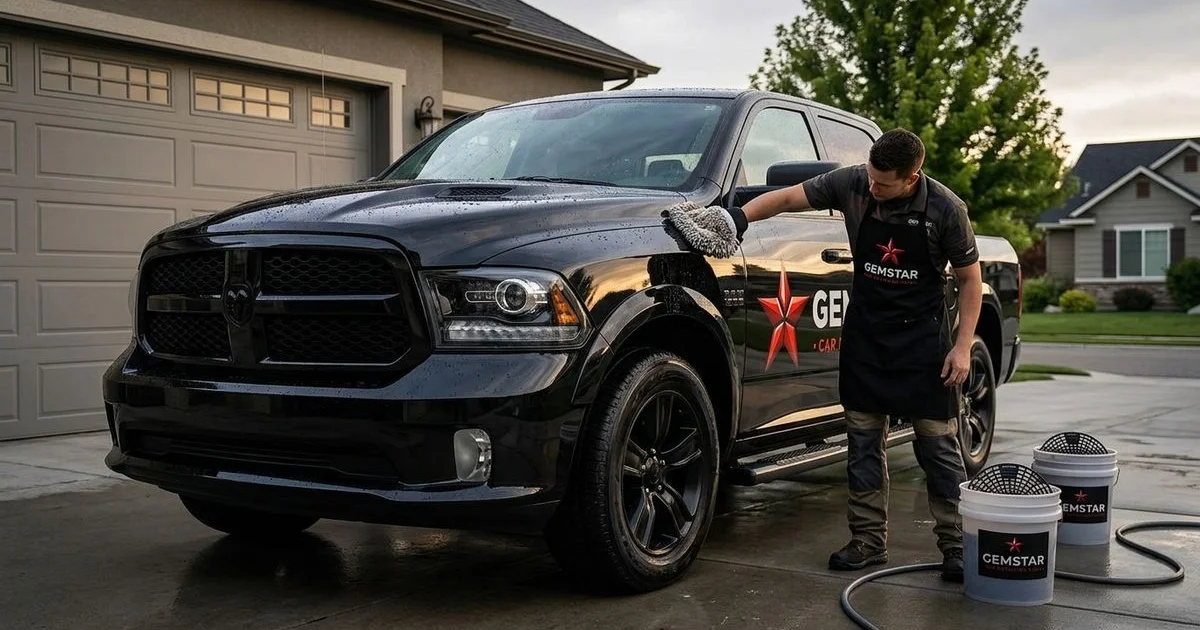
The two-bucket strategy isolates dirt to protect the paint from scratches. This simple system separates your soapy water from the filthy rinse water.
We guarantee you never rub sharp sediment back into the clear coat with this method.
- Bucket 1: Fill with pH-neutral car shampoo and insert a plastic Grit Guard at the base.
- Bucket 2: Fill with plain, clean rinse water and add a second Grit Guard.
- The Wash Cycle: Dip your mitt in the soap, wash a single panel, and then aggressively rinse the mitt in Bucket 2.
- Direction: Work from the roof down to the dirtier lower sections.
- Drying: Use thick microfiber drying towels instead of an old-fashioned chamois.
DIY wash supplies
Our experts recommend stocking up on specific supplies to combat hard water effectively. A basic sponge and dish soap will ruin your vehicle’s protective coating. Proper lubrication and dirt suspension are critical for safe cleaning.
We suggest a loadout focused on the exact tools needed for a flawless finish.
- pH-neutral car shampoo: Products like Meguiar’s Gold Class or Sonax Gloss Shampoo prevent the stripping of your protective sealants.
- Two 5-gallon buckets: Equip both with bottom Grit Guards to trap heavy particles.
- Microfiber wash mitt: The deep pile pulls dirt away from the surface better than flat sponges.
- Two large microfiber drying towels: These quickly absorb moisture to prevent calcium spots.
- Soft wheel brush: Keep this completely separate from your paint tools to avoid transferring brake dust.
When to skip DIY
The wrong environment actually causes more problems than leaving the car dirty. Freezing water damages door seals and sudden temperature shifts stress the cold paint below 32°F.
Our team pauses exterior work during active wind because gusts blow abrasive agricultural dust directly onto soapy vehicles.
- Below 32°F: Water freezes on contact, causing thermal stress.
- Direct sunlight on hot panels: Our local 90-degree summer heat bakes the 137 PPM hard water into permanent calcium spots before you can dry them.
- Active dust event or wind: Gusts blow abrasive agricultural dust directly onto your wet vehicle.
We suggest leaving the job to professionals when the weather works against you. You can see exterior detailing tiers for professional service options that bypass these issues.
Figuring out how often wash car Kuna conditions dictate is the first step to maintaining your vehicle. Our experts are ready to set up a regular, damage-free maintenance schedule for you today.